
Outdoor LED displays are shifting toward higher peak luminance and HDR-like pixel tone mapping for outdoor legibility and impact. Systems combine dynamic backlighting, local dimming and ambient sensing to preserve color fidelity and reduce power draw LED panel. Ruggedized alloys, UV-stable coatings, IP/NEMA-rated enclosures and corrosion-resistant hardware extend lifespan and simplify lifecycle costs. Modular cabinets and hot-swappable modules minimize downtime. Networked telemetry, secure OTA updates and AI-driven energy and maintenance controls improve uptime and OPEX — further sections explain practical implementation and metrics.
Enhancing Visibility: High-Brightness and HDR-Like Rendering
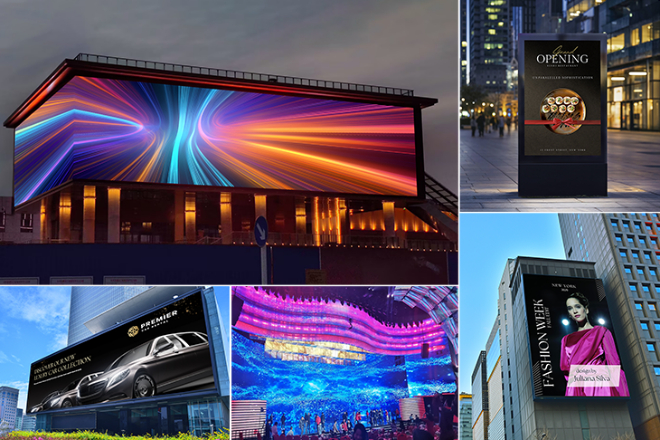
While outdoor environments expose displays to direct sunlight, high-brightness and HDR-like rendering technologies enable consistent legibility and improved visual impact by combining peak luminance, dynamic backlight control, and expanded pixel-level tone mapping. The segment emphasizes measurable performance: nits LED advertising board, contrast ratio, and local dimming granularity framed against real-world viewing angles. Ambient sensors feed automated brightness scaling to preserve color fidelity while minimizing power draw. Integrated color calibration routines make certain brand-consistent reproduction across installations and over time, reducing field service cycles. Vendors position these systems to attract advertisers and operators seeking visual authority and operational freedom. Procurement criteria prioritize scalable luminance, adaptive control logic, and compatibility with networked content management, enabling owners to deploy high-impact outdoor displays with predictable, efficient outcomes.
Built to Last: Materials, Coatings, and Modular Maintenance
Built from corrosion-resistant alloys, impact-tough polymers, and UV-stable coatings, modern outdoor LED displays are engineered for multi-year exposure to sun, salt, and particulate pollution. Manufacturers specify weatherproof enclosures with defined IP and NEMA ratings, gasketing systems, and drainage paths to prevent ingress and enable predictable maintenance cycles. Surface treatments—anodizing, powder coats, and ceramic clearcoats—extend service life while preserving thermal paths. Structural joints use corrosion resistant fasteners and captive hardware to reduce loosening under vibration and thermal cycling. Modular cabinet architecture prioritizes front access, standardized connectors, and swappable power and pixel modules to minimize downtime and logistic burden. Buyers evaluate total cost of ownership by lifecycle testing, repair time objectives, and replacement-part availability to retain operational freedom and reduce vendor lock-in.
Smarter Screens: Remote Management, AI Controls, and Energy Efficiency
Leveraging networked telemetry and edge compute, outdoor LED displays now integrate remote management platforms, AI-driven content and health controls, and power-optimization strategies to reduce operating expense and improve uptime. Manufacturers and operators deploy remote diagnostics to monitor pixel integrity, thermal profiles, and environmental ingress, enabling secure over-the-air updates and immediate fault isolation. AI models adapt content scheduling to ambient light, audience patterns, and energy tariffs, lowering consumption without compromising impact. Predictive maintenance algorithms analyze vibration, current draw, and component drift to forecast failures and schedule targeted service, minimizing downtime and inventory burden. These capabilities create scalable, vendor-agnostic ecosystems that prioritize operational freedom, transparent SLAs, and measurable total cost of ownership improvements for outdoor digital signage portfolios.
Frequently Asked Questions
How Do LED Displays Handle Vandalism or Graffiti Protection?
They resist vandalism through anti graffiti coatings and tamper resistant enclosures, combining hardened glass, recessed fixtures, and quick-clean chemistries. Manufacturers market robust serviceability, modular replacement, and remote monitoring to preserve appearance and uptime.
Can Outdoor LEDS Be Recycled at End-Of-Life?
Yes. The industry recycles outdoor LEDs: reclaimable components (metals, PCBs, modules) are separated, enabling eco friendly disposal streams. Technical processes and market services support material recovery, regulatory compliance, and cost‑efficient end‑of‑life options.
What Permits Are Required for Installing Large Outdoor Displays?
Typically, zoning approvals and electrical permits are required for large outdoor displays. Additional permits may include building permits, sign permits, and environmental or historic reviews; the operator should verify local jurisdictional requirements and timelines.
How Do Extreme Cold Temperatures Affect LED Performance?
Extreme cold reduces luminous output and can shift color; low temperature brightness degrades initially but often recovers. Buyers value thermal cycling resilience and ruggedized drivers to guarantee reliable performance, minimizing maintenance and preserving display freedom.
Are There Health Concerns From Prolonged Exposure to Bright Outdoor LEDS?
Prolonged exposure can pose risks: blue light contributes to circadian disruption, increases headache risk, and may, at high intensities or with prolonged glare, elevate retinal damage potential; market solutions emphasize shielding, dimming, and spectral tuning.
Conclusion
Advances in outdoor LED displays are consolidating around three market-driven priorities: amplified luminance with HDR-like rendering to guarantee message clarity in variable ambient conditions; ruggedized materials, protective coatings, and modular designs that reduce lifecycle costs and downtime; and intelligent control layers leveraging remote management, AI optimization, and power-saving strategies to maximize return on investment. Together, these trends enable more effective, reliable, and cost-efficient signage solutions that address evolving regulatory, environmental, and commercial requirements.